












LLM Integration
Connect Large Language Models to Your Business Systems, Data, and Workflows
Large language models can easily be connected to your business applications and data and help employees find information, summarize records, draft communications, and complete parts of everyday workflows.
At Stickboy AI, we help businesses to integrate large language models into existing systems, custom applications, and business processes. We focus on practical implementations that fit your technology environment, support your team’s needs, and account for security and access requirements.
Trusted by Industry Leaders
What Is LLM Integration?
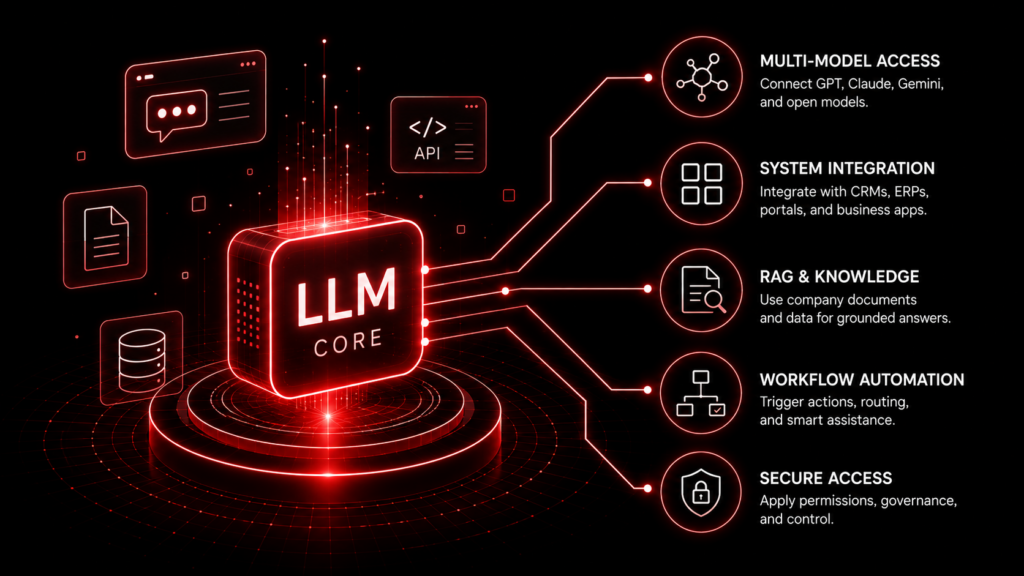
Large language model (LLM) integration connects AI models to business applications, data sources, and workflows. Employees can use AI capabilities within the systems they already depend on, instead of switching between separate tools.
For example, an integrated LLM helps a sales team to summarize customer records, assist a support team with ticket responses, or help employees find answers in internal documents. Depending on the implementation, it may also connect to APIs and approved workflow tools to support specific business actions.
Stickboy AI helps businesses identify suitable integration opportunities and connect AI models with the systems, information, and processes needed to support them.
20+
AI use cases scored per engagement
90
Day execution roadmap delivered
2–3
Weeks assessment to roadmap delivery
35+
Clients served since 2007
Build & Integrate
LLM-Powered Application Features
Stickboy AI helps businesses connect large language models with existing software, business data, and application workflows. The integration depends on your goals, technology environment, model requirements, and the tasks you want AI to support.
CRM, ERP, and Business System Integration
Connect AI capabilities with the applications your employees use to manage customers, projects, orders, and daily operations.
We help integrate LLMs with systems such as:
- Customer relationship management (CRM) platforms
- Enterprise resource planning (ERP) systems
- Accounting applications
- Project management platforms
- Inventory management systems
- Customer portals
- Support ticketing systems
- Order management systems
- Sales pipelines
- Internal databases
- Custom business applications
Depending on the systems and permissions involved, these integrations help users retrieve relevant records, summarize customer or project information, draft updates, and access information without manually searching across multiple applications.
The objective is to make AI useful within existing business processes instead of creating another disconnected tool.
Secure LLM Integration
Connecting an LLM to business systems requires careful decisions about data access, permissions, and the actions the model can request.
Stickboy AI helps businesses account for security and governance requirements when designing AI integrations.
Depending on the application, relevant controls may include:
- Role-based access control
- User permission filtering
- Secure API authentication
- Data privacy controls
- Restrictions on sensitive information
- Protection against prompt injection
- Audit logging
- Human approval workflows
- Output validation
- Model and vendor review
- Data retention considerations
These controls should reflect the system’s intended use, the sensitivity of the information involved, and the level of access granted to the AI application.
A well-designed integration should clearly define what information the model can access, what actions it can request, and where human approval is required.
Multi-Model Integration
Different language models have different capabilities, costs, latency characteristics, and deployment options. The right choice depends on what your application needs to do.
We help evaluate and integrate suitable models for your use case, which may include:
- OpenAI GPT models
- Anthropic Claude models
- Google Gemini models
- Open-source large language models
- Private or self-hosted models
- Embedding models for semantic search
- Vision-language models for image-related tasks
- Speech and transcription models
The selection process should consider the task, expected response quality, data requirements, integration complexity, operating costs, and deployment constraints.
Where appropriate, an application may use different models for different tasks. Model selection should be based on the requirements of the solution instead of the assumption that one model is best for every situation.
AI Assistant Integration
An AI assistant helps employees or customers interact with information and application features through natural-language requests.
We help businesses integrate AI assistants into internal systems, portals, and customer-facing applications where they serve a clear purpose.
Depending on the implementation, these assistants can help users:
- Ask questions about accessible business data
- Search internal documents
- Summarize customer and project records
- Draft emails and other communications
- Review documents
- Find policies and procedures
- Understand process requirements
- Generate reports and summaries
- Retrieve relevant information from connected systems
- Identify possible next steps
For assistants that use company documents or other internal knowledge sources, retrieval-augmented generation (RAG) can help retrieve material to provide context for answers.
The quality of the experience depends on the underlying data, retrieval methods, permissions, model behavior, and testing. AI-generated responses should be checked when accuracy is important to a business decision or customer interaction.
API and Workflow Automation
LLMs can work with APIs and workflow tools to support processes that involve more than generating text. With the right integrations and permissions, an AI-enabled application helps prepare information, route requests, and initiate approved actions.
Potential applications include:
- Creating tasks from submitted requests
- Updating approved fields in business records
- Routing support tickets
- Drafting customer emails
- Generating reports from connected information
- Summarizing from submissions
- Classifying incoming inquiries
- Extracting fields from documents
- Sending notifications
- Supporting approval workflows
Workflows that involve sensitive records, financial activity, customer commitments, or important business decisions may need validation or human approval before changes are made.
The goal is to connect language-model capabilities to useful business processes while maintaining appropriate control over the actions performed.
What You Unlock
What You Unlock
LLM Integration Built Around Your Business Needs
Connecting a language model to your business systems should solve a specific problem. The value comes from how well the integrations fit your workflows, use relevant information, and support the people who rely on them.
More Useful Business Applications
Add AI capabilities to existing applications so employees can search information, summarize records, and complete supported tasks within familiar workflows.
Better Access to Information
Connect language models to approved business data and knowledge sources so users can retrieve relevant information without manually searching multiple systems.
Workflows That Reduce Manual Effort
Identify repetitive information-handling tasks that could benefit from AI assistance, such as classifying requests, drafting updates, or preparing document summaries.
Integration That Fits Your Technology Environment
Consider existing applications, APIs, data sources, and infrastructure when selecting an integration approach. This helps avoid building an isolated AI tool that doesn’t fit the way your business operates.
Case Studies: AI in Action
Real Business Transformation
What is LLM integration?
LLM integration connects a large language model to business applications, data sources, or workflows. It allows an application to use AI for tasks such as summarizing records, answering questions, drafting communications, or assisting with business processes.
What is the difference between LLM integration and Generative AI?
Generative AI refers to AI systems that can generate or transform content, including text, images, and other outputs. An LLM is a type of AI model designed to process and generate language. LLM integration is the process of connecting such a model to applications, data, or workflows so its capabilities can be used within a business environment.
Can an LLM connect to our existing CRM or ERP?
Yes, if the relevant system supports a suitable integration method and the required permissions are available. Depending on the application, an LLM-enabled solution may retrieve records, summarize information, draft updates, or assist with supported workflows. The exact capabilities depend on the system’s APIs, data structure access controls, and implementation requirements.
Which LLM should our business use?
The right model depends on the intended tasks, response quality, cost, latency, privacy requirements, and deployment options. Some applications may benefit from a hosted model, while others may have reasons to consider an open-source or self-hosted option. Testing models against representative business tasks can help inform the decision.
Can LLMs work with our internal documents and databases?
Yes, an application can connect an LLM to approved information sources through retrieval systems, APIs, or other integration methods. RAG is one approach that retrieves relevant documents or passages and supplies them as context for a response. Data quality, retrieval accuracy, and access permissions remain important to the solution’s reliability.
Client Testimonials
Driving Intelligent Growth for Our Clients
Ready to Make Your Business AI-Ready?
Connect AI to the Work Your Business Already Does
Large language models can support much more than standalone conversations. With the right integration, they can help employees work with business information, add useful features to existing applications, and support selected workflows.
We at Stickboy AI help you explore where LLM integration fits your systems and goals. Let’s discuss your current technology environment, the tasks you want to improve, and the practical steps required to bring AI into your business.
Client Testimonials


