





AI Governance
Build AI Systems Your Business Can Trust
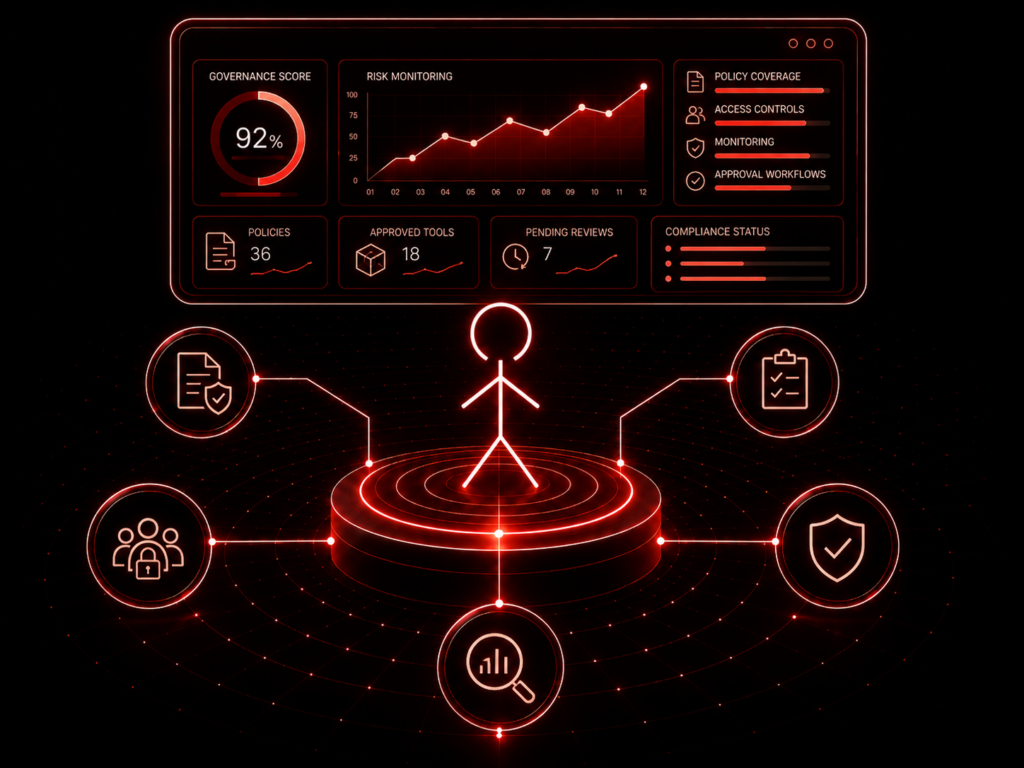
Stickboy provides AI governance services that help businesses establish clear rules, responsibilities, and controls for how AI is used across their organization.
With technology experience since 2007, we combine AI, software development, security, cloud, and IT expertise to help businesses make informed technology decisions. Our approach to AI governance focuses on the systems, data, workflows, people, and business requirements that shape how AI is actually used.
From generative AI and AI agents to automation, RAG systems, and internal AI tools, we help organizations create an AI governance framework that supports responsible use without creating unnecessary barriers for their teams.





Trusted by Industry Leaders



Why AI Governance Matters
AI adoption needs clear rules, accountability, and oversight.
As businesses introduce generative AI, AI agents, automation, RAG systems, and other AI tools, employees can quickly end up using different platforms and workflows without consistent guidance. This makes it difficult to know what information can be shared, which tools are approved, who can access AI capabilities, and when human review is required.
Our AI governance consulting helps create a practical framework for managing these decisions. We review your existing systems, data, workflows, AI use cases, and business requirements to establish guidelines that fit the way your organization operates.
Our goal is to give your teams a clear and consistent way to use AI while identifying and managing business, operational, security, privacy, and compliance risks.
20+
AI use cases scored per engagement
90 Days
execution roadmap delivered
2–3 week
assessment to delivery
35
Clients served since 2007
Why AI Governance Matters
As businesses begin using generative AI, AI agents, automation, RAG systems, and internal AI tools, they need clear guidelines for how AI should be used.
Give employees clear guidelines for using AI at work.
A good AI usage policy should answer practical questions employees face every day. Instead of leaving teams to interpret AI risks on their own, we help establish clear internal guidelines around approved tools, restricted information, review requirements, and business use cases.
Your AI usage policy may define:
- Which AI tools are approved for business use
- What information employees can share with AI systems
- What confidential or sensitive information should not be entered
- When AI-generated content requires human review
- How AI-assisted work should be documented
- Which AI use cases require leadership approval
- When employees should escalate an AI-related concern
- How approved AI tools should be used across departments
These clear policies assist employees in understanding what is expected while giving leadership greater visibility into how AI is being used across the organization.
Protect business information as AI becomes part of everyday workflows.
AI governance begins with understanding what information your AI systems can access and how that information is being used. At Stickboy, we help define governance rules around the types of data that require additional controls or restrictions.
This can include:
- Customer data
- Employee data
- Financial information
- Legal documents
- Contracts
- Internal business processes
- Operational data
- Confidential company information
These guidelines can then be connected to the way your employees, applications, AI tools, and automated workflows actually operate. This creates a more consistent approach to deciding what AI systems can access and how sensitive information should be handled.
Not every user needs access to every AI capability.
Different employees and departments may use AI in different ways. An employee using an AI assistant to summarize internal information does not need the same access as an administrator managing an AI agent connected to business systems.
Our AI governance framework can help define appropriate permissions based on roles, responsibilities, data access, and the type of AI capability being used.
Governance considerations can include:
- Department-level access
- Administrator permissions
- Customer-facing versus internal AI tools
- Restricted document access
- Approval-based AI workflows
- Restricted document access
- Approval-based AI workflows
- Read-only versus action-taking AI agents
- Access to sensitive business information
- Permissions for third-party AI platforms
The objective is to create clear boundaries around who can access AI capabilities and what those capabilities can access.
Keep people accountable for important AI-assisted decisions.
AI can assist with business processes, but organizations still need to determine where human review or approval belongs in the workflow. We help identify situations where an AI-generated result should be reviewed before it is shared, approved, or used to trigger an action.
Examples can include:
- Reviewing AI-generated customer communications
- Checking AI-written proposals or contracts
- Validating compliance-related summaries
- Reviewing AI-generated recommendations
- Approving system changes triggered by AI
- Escalating low-confidence or unusual AI outputs
- Confirming actions before AI agents execute
This approach helps establish clear decision points between AI-generated outputs and business actions.
Understand the risk associated with each AI use case.
Not every AI application creates the same level or type of risk. A low-impact internal productivity tool may require different governance controls than an AI agent that accesses sensitive information or takes actions inside a business system.
Our AI risk assessment process evaluates AI use cases based on factors such as:
- Data sensitivity
- Customer or employee impact
- Compliance exposure
- Level of automation
- Human review requirements
- Accuracy requirements
- Business-critical dependency
- Security and access concerns
- Potential consequences of incorrect outputs
The assessment provides a structured way to identify where additional policies, controls, reviews, or approvals may be appropriate.
What You Unlock
A Clear Way to Manage AI Across Your Organization
Effective AI governance gives leadership and employees a shared framework for making decisions about AI. Instead of treating every new AI tool or use case as a separate question, your organization can use defined policies, responsibilities, risk considerations, and approval processes.

Clear AI Policies
Employees understand which tools and workflows are approved and what information should be protected.

Better Risk Visibility
Leadership identifies higher-risk AI use cases and determines where additional controls or human review may be needed.

Defined Accountability
Roles and responsibilities are established so AI-related decisions do not fall into an unclear gap between technology, business, security, and leadership teams.
Consistent AI Adoption
Departments can work from shared governance requirements instead of creating disconnected rules for AI use.
More Controlled AI Automation
AI agents and automated work can be evaluated according to their access, actions, business impact, and required approval points.
Ongoing Governance
Your framework can be reviewed and adjusted as AI tools, business processes, regulations, and organizational requirements evolve.
Case Studies: AI in Action
Real Business Transformation


What is AI governance?
AI governance is the set of policies, responsibilities, processes, and controls an organization uses to manage how AI is developed, deployed, accessed, and used.
Why does a business need an AI governance framework?
An AI governance framework helps establish consistent rules for AI usage, data access, human oversight, risk management, accountability, and approval processes across the organization.
What does an AI governance policy cover?
An AI governance policy covers approved AI tools, acceptable use, data restrictions, access permissions, human review, AI-generated content validation, documentation, and escalation requirements.
How does AI risk assessment work?
AI risk assessment examines factors such as data sensitivity, business impact, automation level, compliance exposure, accuracy requirements, security, and human oversight to identify appropriate governance controls.
Does AI governance apply to generative AI and AI agents?
Yes, AI governance applies to generative AI tools, AI agents, automation workflows, RAG systems, internal AI applications, and other AI technologies used within an organization.

Client Testimonials
Driving Intelligent Growth for Our Clients
Ready to Build a More Controlled AI Environment?
AI adoption does not have to mean giving up control over how technology is used. Stickboy helps you establish practical AI governance policies, risk assessments, access controls, human oversight, and processes that fit your organization.
Start building an AI governance framework that gives your team clear rules for using AI responsibly.

Client Testimonials